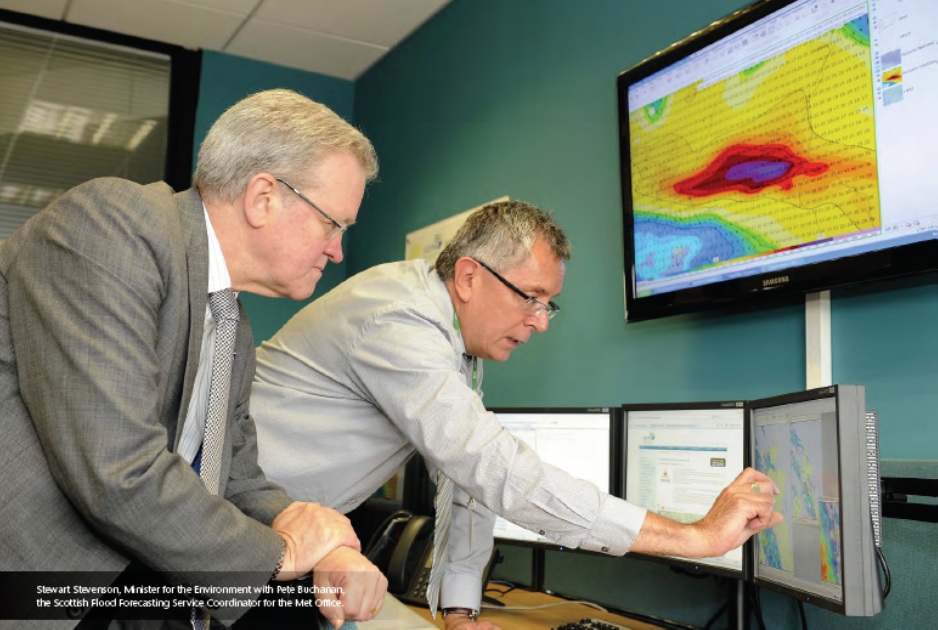
Decision making in times of uncertainty: the forecaster

In a two-part feature, we cover various roles involved in decision making at times of uncertainty. The first is provided by Paul Ryles, Senior Scientist and operational flood forecaster at SEPA.

PR pic

Paul manages SEPA’s flood risk management and operational hydrometeorology trainee programmes and has been in flood warning service development since 2002

“Flood prediction is a science, especially in challenging situations such as providing long lead times (for example through our five day flood guidance statement) or flash flooding (surface water alerting). One of the primary roles of the flood forecaster in these situations is in communicating uncertainty in a way that is useful for responders. The forecaster must quantify uncertainties in the weather forecast (in terms of location, timing, intensities and amounts of rainfall) and any potential uncertainties in the resultant flood forecasting predictions and hazard footprint.

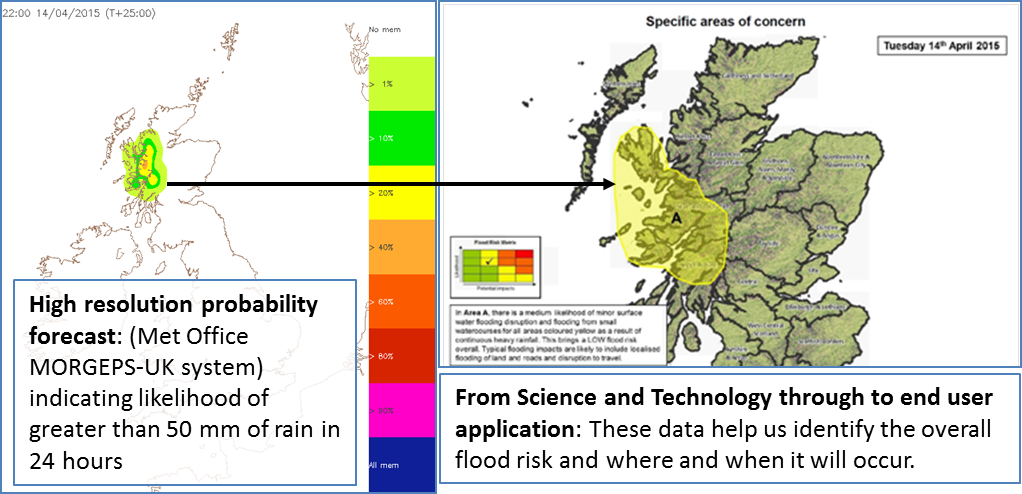
Meteorological and hydrological tools such as MOGREPS and Grid-to-Grid provide the forecaster with the opportunity to quantify uncertainty in flood predictions. Image of MOGREPS-G and probability of greater than 25mm in 24 hours ahead of ex-Hurricane Kate (Copyright Met Office)

Meteorological and hydrological tools such as MOGREPS and Grid-to-Grid provide the forecaster with the opportunity to quantify uncertainty in flood predictions. Image of MOGREPS-G and probability of greater than 25mm in 24 hours ahead of ex-Hurricane Kate (Copyright Met Office)

Understanding what type of information customers require is vital, as is an appreciation of how this information will be used and what type of decision will be made. The flood forecast will often be used to make crucial ‘yes or no’ decisions, such as committing resources in responding to a flood event, evacuations or deploying temporary flood prevention measures. Understanding these customer requirements is as vital as knowledge of meteorology and hydrology in producing successful flood forecasts.

2015 Sep 23_7043

Flood Forecasters participating in Exercise Big Water, testing response and preparedness to new coastal flood forecasting capabilities.

Having competent and experienced flood forecasters is essential in delivering this service. To this end, the Flood Forecasting Service, with support from the Met Office College, has developed a formal qualification in Operational Hydrometeorology. The aim is for all of our flood forecasters to achieve this qualification, which assesses all aspects of producing and communicating our flood forecasts. The forecasters, who will already have completed training in flood forecasting, warning and response, will undertake this qualification after a period of on-the-job training.

Forecasting some flood situations remains a challenge, however ensuring all flood forecasters are trained and competent (and assessed) in accounting for, quantifying and communicating risk at times of uncertainty should maximise the benefit of flood predictions for responders when making difficult decisions.”

Posted in Forecasting, Hydrometeorology, Risk communication | 1 Comment

Flood forecasting: current challenges and future aspirations

How can flood forecasting best rise to the challenges and opportunities that communities and partners face; at what point does effort in flood forecasting become less effective than local adaptation; and what are the aspirations and capability of our future flood forecasting services – all questions posed for the speakers at this one-day conference in Birmingham.

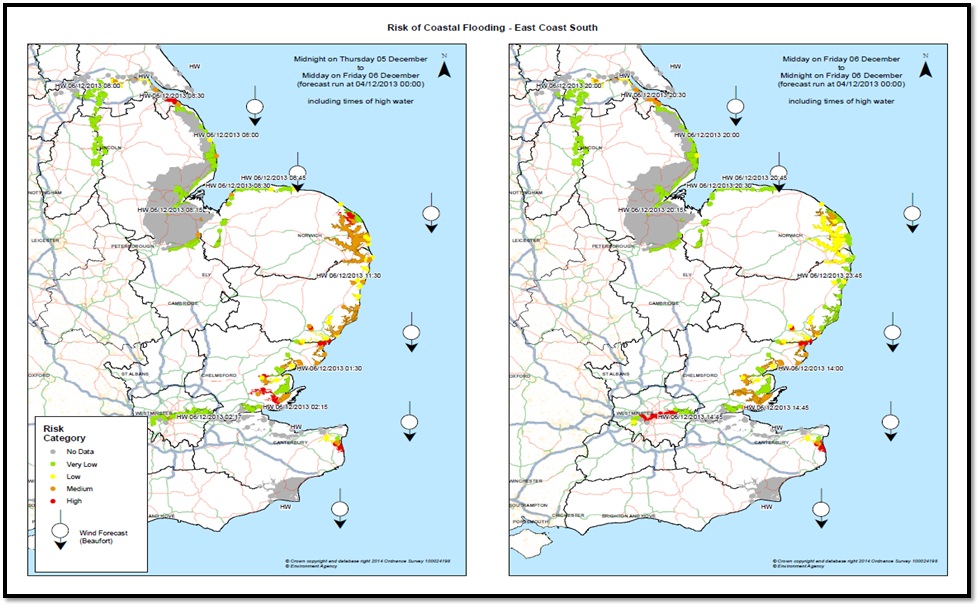
Pilot capability for a risk-based coastal decision support tool. (source: Environment Agency)

Pilot capability for a risk-based coastal decision support tool. (source: Environment Agency)

The growth of flood forecasting or hydrometeorology as a science and its associated services is evident given the range of presentations. Products such as the five-day flood guidance statement – ground breaking when introduced 5 years ago – is now firmly a part of the flood response environment with a new appetite for longer lead times (Turner) and more challenging local applications such as wave overtopping forecasting at the community and asset scale (Wall; Lawless). So what are the key challenges and aspirations:

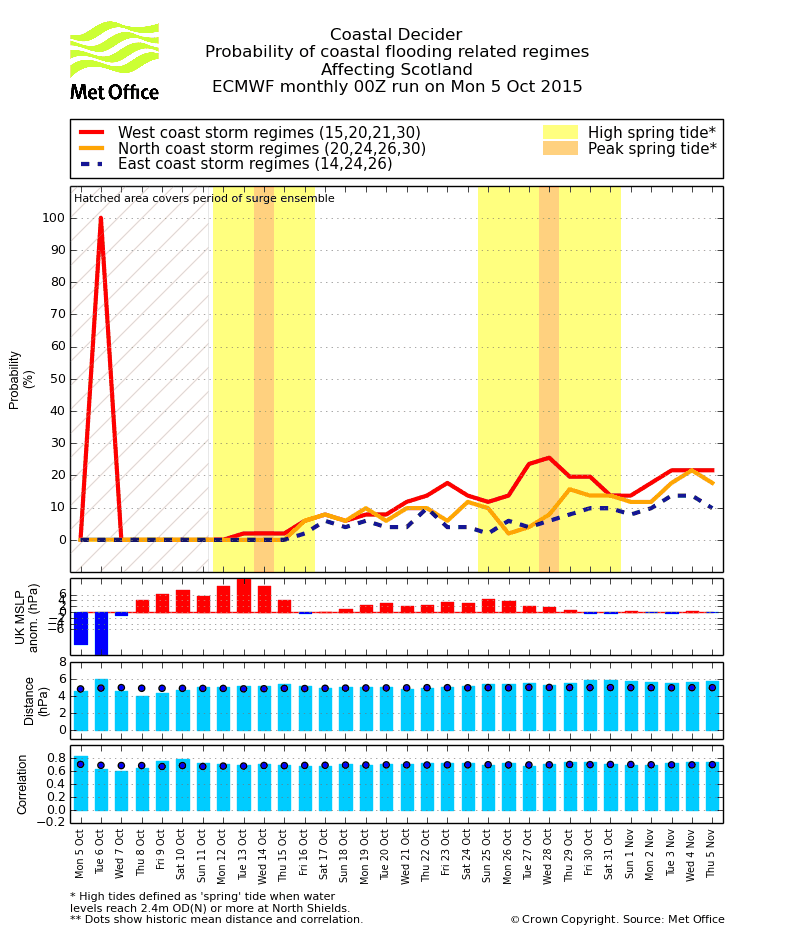
Coastal decider tool providing a 32-day look at the probability of coastal flooding related weather types. (source: Met Office)

Coastal decider tool providing a 32-day look at the probability of coastal flooding related weather types. (source: Met Office)

Who are the customers of our forecasts?
Forecasts are no longer there to purely support the issuing of flood warnings. The type and range of forecasts vary and agencies are grappling with the idea of what to forecast, where and for who given the growing desire for forecast data. Policies in England are now focused on making forecasts more accessible and usable (Anspoks), whilst at a community level these need to sit alongside local tool-kits and support the potentially powerful use of social media by flood groups (Barnes). The desire to receive ‘everything’ (Young) should also be offset with the need to facilitate and support users of the forecast information (Rowlands and Williams).

How good are the forecasts?
Investment in our services is under increasing scrutiny especially with continued funding pressures in the public sector, therefore prioritising effort where it’s most needed for improvement is important. An example was presented of a framework to integrate flood model forecast assessment studies for local and national scale models to provide an evidence base for flood forecasting model development (Moore) – one to assist in future decision making.

Are they understood?
The case for the difficulties in effectively communicating flood forecasts was made by a number of speakers with the recent severe flooding in the south of France being highlighted (Mitchell). When the Somerset levels flooded in 2014, the impacts were felt for several months with the Environment Agency incident room being staffed continuously for 11 weeks and 3 days. One response from someone affected was that ‘the water came so quickly’; however it’s interesting to note that the first Flood Alert predicting the impacts was issued some 16 days before the first property was impacted (Rowlands and Williams).

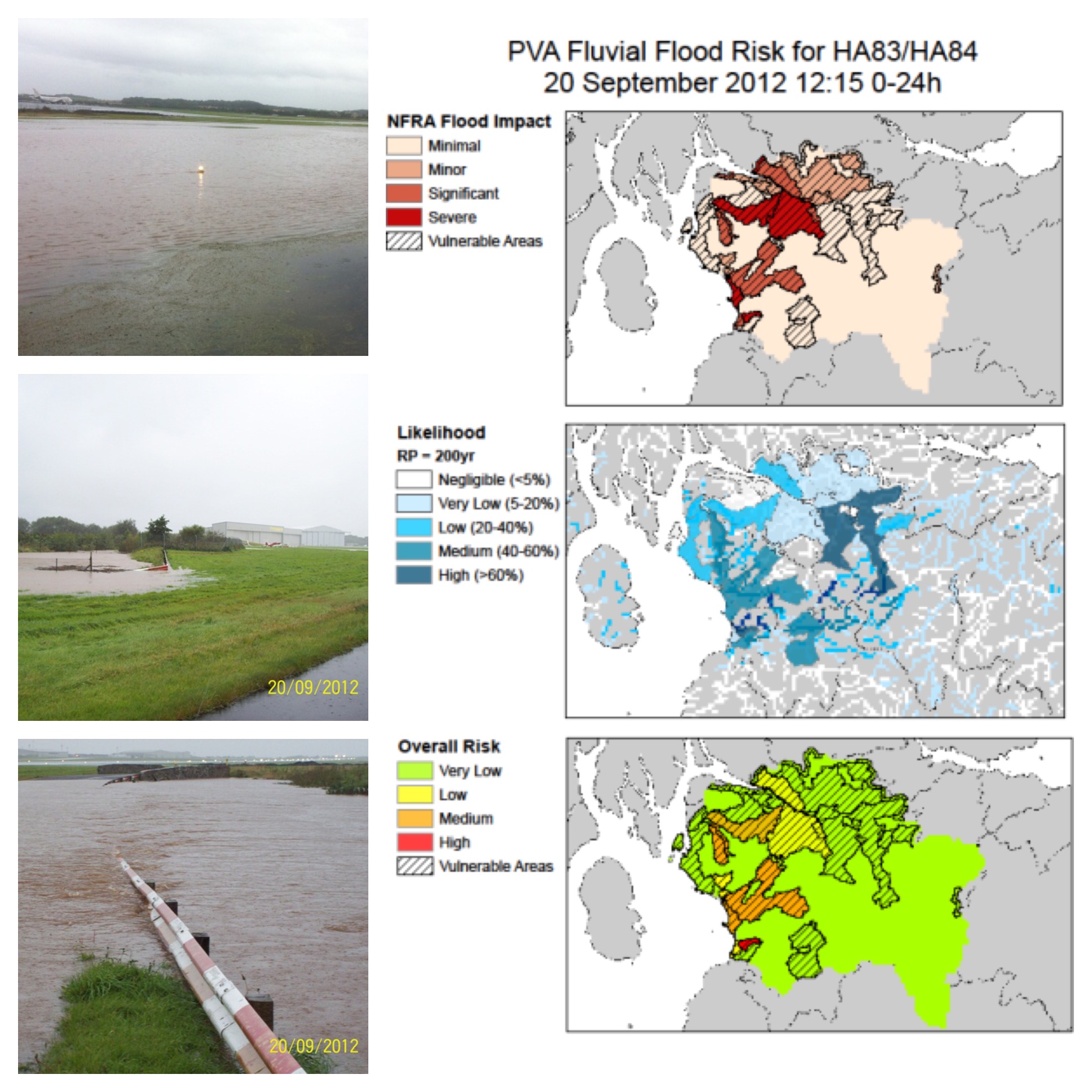
Prototype fluvial flood risk forecast maps using G2G hydrological ensembles in conjunction with NFRA flood impact data presented for flooding affecting Prestwick Airport in 2012. (Photos left source: Prestwick Airport; Maps right source: CEH Wallingford)

Prototype fluvial flood risk forecast maps using G2G hydrological ensembles in conjunction with NFRA flood impact data presented for flooding affecting Prestwick Airport in 2012. (Photos left source: Prestwick Airport; Maps right source: CEH Wallingford)

Do they reflect the impacts well enough?
One speaker referred to this area as ‘making the forecasts come to life’. Effort is now being put into translating flood forecasts into risk-based flood impact assessments, with frameworks being developed for inundation mapping (Whiting), coastal flood risk decision support (Anspoks) and our own prototype forecast river hazard mapping in Scotland (above).

Posted in Conference, Forecasting, Hydrometeorology, Risk communication | Leave a comment

Heavy Rainfall Alerts – latest advances

In order to provide probabilistic forecasts of flooding from surface water the forecasting service has been using a Heavy Rainfall Alert (HRA) tool since 2013, as discussed in a previous article. The tool consists of a spreadsheet that is updated four times a day and emailed to the forecasting duty officer, and a series of maps. After two years of use we have reviewed the tool and made some improvements to the spreadsheet, adding new functionality and making it more user friendly.

As before, the tool uses MOGREPS-UK forecasts subjected to neighbourhood sampling (over 60km) to calculate the probability of exceeding depth duration thresholds (that have been defined in terms of expected impact), within specified operational areas. The new tool now has two key innovations.

hra pix

Areas assessed by the tool. Point maxima (left) and catchment averages (right)

  1. Urban areas

In the new tool an assessment of depth-duration threshold exceedence is made for each of seven urban areas. These areas are each around 1000km2, which is believed to be the optimum size for trading off event probability and usefulness of forecast. Now, by looking at the spreadsheet, the forecaster can see at a glance which urban areas might be affected. Previously, she would only have had information on exceedences within a larger area, and there might not have been any information immediately to hand to confirm whether or not the urban area was at risk.

2. Fast responding catchments

The other innovation relates to a new assessment of 16 catchments. These are all small, rapidly responding, flood prone catchments, where early warning of potential river flooding is required. Catchment average depth duration thresholds for various levels of impact have been calculated. The tool calculates exceedence of these thresholds by the areal average of these catchments, as opposed to the point maxima used previously. This is quite an innovation, and is the first time that the HRA process has been used in this way within the UK.

hra table.png

Example excerpt from the tool

  1. Other improvements

In addition, a first guess risk tool has been built in to the spreadsheet, combining impact and likelihood. Maps, lists of thresholds and user guidance are also included to make the tool user friendly.

As has been seen more than once this summer, the ability to focus risk based forecasts for surface water and rapid response catchments is critical to enable effective emergency response, and so the improved tool should go a long way towards helping us to meet that challenge.

Posted in Forecasting, Probabilistic, Risk communication, Surface Water | Leave a comment

The July Perthshire floods: hydrometeorological predictions

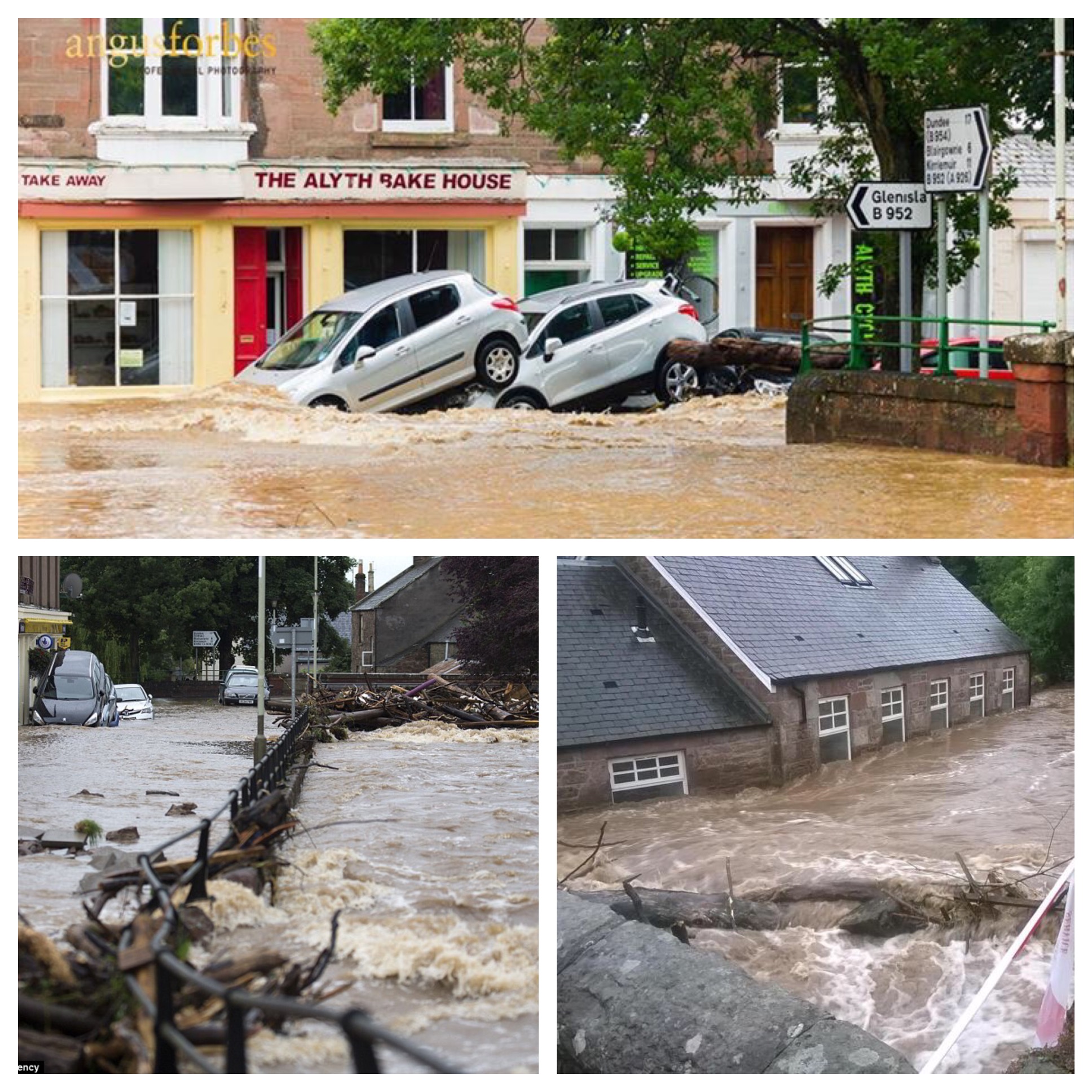
Figure 1: Flooding impacts in Alyth.  Clockwise from the top: Cars swept along Commercial Street in Alyth (source: Angus Forbes Photography); flood waters into properties (source: Michelle Macleod); and debris and damage caused by the Alyth Burn (source: Perthshire Picture Agency)

Figure 1: Flooding impacts in Alyth. Clockwise from the top: Cars swept along Commercial Street in Alyth (source: Angus Forbes Photography); flood waters into properties (source: Michelle Macleod); and debris and damage caused by the Alyth Burn (source: Perthshire Picture Agency)

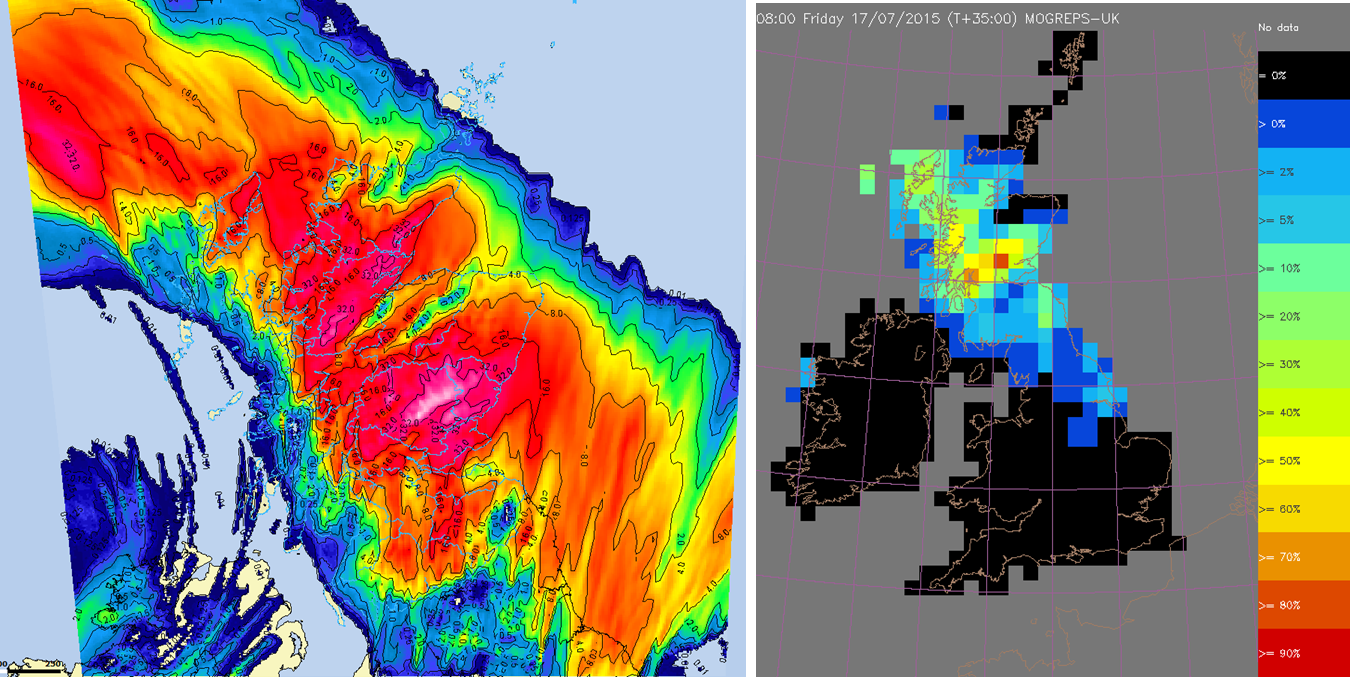
A major clean-up operation is underway following flooding that affected some Perthshire communities on the 17th July 2015. Villages such as Bankfoot were affected and surface water flooding was seen across much of the road network; however the flooding impacts were most critically witnessed in the town of Alyth. During the morning of the 17th July, serious flooding from the Alyth Burn resulted in the evacuation of 70 homes and businesses, significant impacts on bridges, with cars being swept along due to the force of the water, and over 750 properties being left without power. The spell of heavy rain originated from an occluding frontal system associated with a low centre near North West Ireland which tracked northwards across Perthshire on Friday morning. It was an active frontal system with the rainfall amplified by uplift over the hills with embedded heavy showers. Numerical weather prediction models were highlighting this area well; the UKV model was estimating a broad area of 30 to 40mm in 6 hours and MOGREPS-UK (ensemble forecasting system) producing a greater than 80% likelihood of more than 30 mm in 6 hours across central Perthshire.

Figure 2: UKV model estimates for rainfall accumulation in 6 hours to midday on the 17th July with a lead time of 24 hours (left) and MOGREPS-UK probability of exceeding 30mm in 6 hours with a lead time of 35 hours (right)

Figure 2: UKV model estimates for rainfall accumulation in 6 hours to midday on the 17th July with a lead time of 24 hours (left) and MOGREPS-UK probability of exceeding 30mm in 6 hours with a lead time of 35 hours (right)

Although the investigation into the cause of the flooding continues, the relatively short duration of the intense rainfall has certainly been a contributing factor. Previous research into flooding impacts carried out by the flood forecasting service suggests that this depth of rainfall over this short duration has the potential to lead to significant flooding. Although there are no raingauges in the immediate vicinity of the Alyth Burn catchment, some raingauges in the area did record significant 6-hour accumulations including Kindrogan (40mm) and Perth (43mm). Radar estimates across the small catchment provide the opportunity to estimate the distributed rainfall depths for the Alyth Burn catchment with totals being estimated in the range of 30mm in Alyth to 42mm in the headwaters.

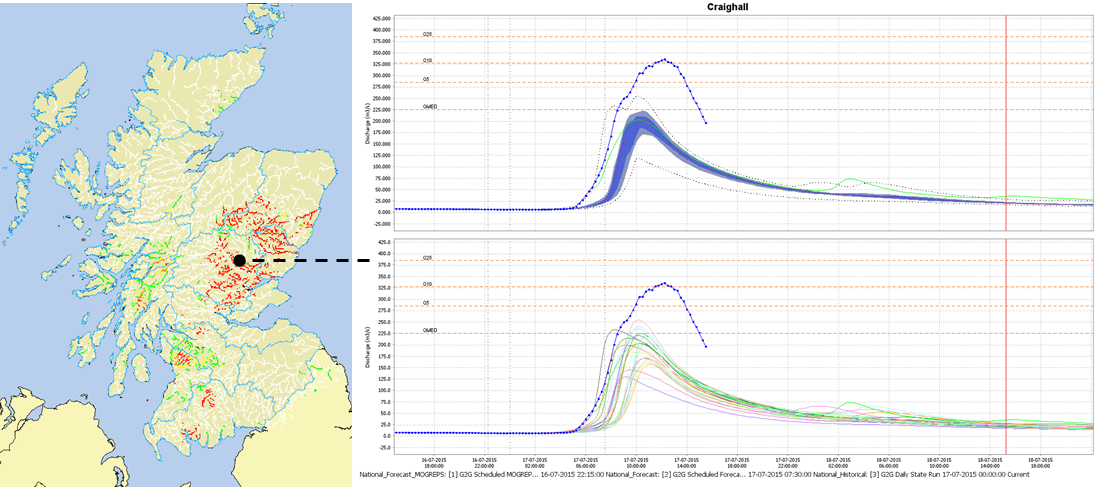
Figure 3: G2G (a 1km distributed hydrological model for Scotland) highlighting areas of greater than 60% of ensemble members above the 2-year warning level (left) and model predictions and observed flows for the Craighall gauging station.

Figure 3: G2G (a 1km distributed hydrological model for Scotland) highlighting areas of greater than 60% of ensemble members above the 2-year warning level (left) and model predictions and observed flows for the Craighall gauging station.

Likewise the hydrological model Grid-to-grid (G2G) was also suggesting likely response in the river systems across Perthshire and Angus. The lack of gauged data for smaller catchments, such as the Alyth Burn, in the area makes it difficult to assess the accuracy of G2G estimated flows, however for some gauged records it appears that the severity of the flows may have been underestimated in places (River Ericht at Craighall observed peak flow estimate 335 and UKV deterministic G2G prediction 226 cubic metres per second).

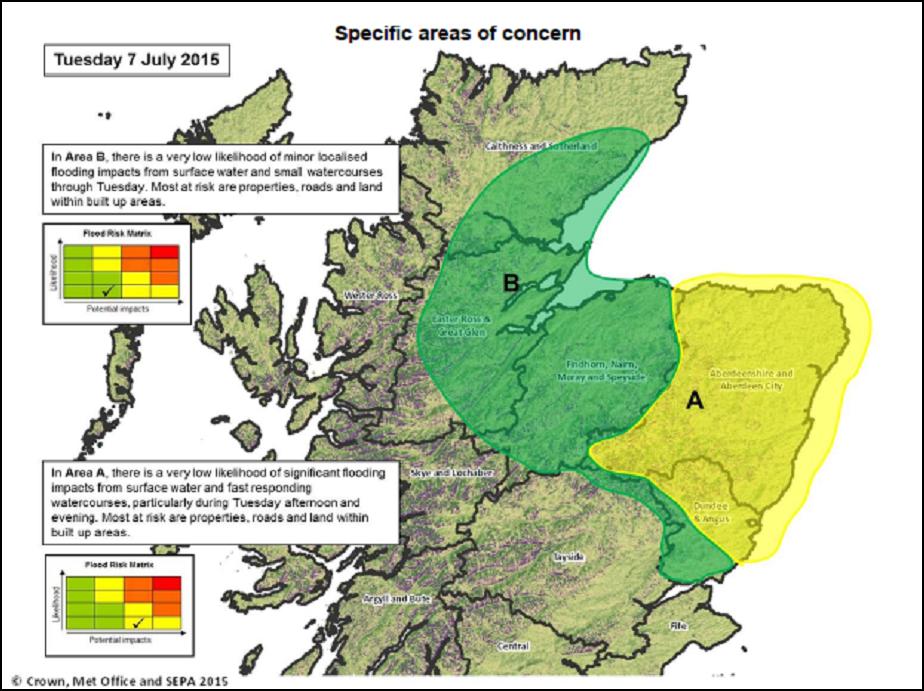
Figure 4: The Flood Guidance Statement area of concern map issued to emergency responders on the 16th July.

Figure 4: The Flood Guidance Statement area of concern map issued to emergency responders on the 16th July.

These forecasting tools were able to allow for the prediction of potential flooding on the 17th. Whilst minor flooding impacts were expected, the Flood Guidance Statement published on the 16th July did indicate the potential for some significant impacts, although the likelihood was very low. Some immediate lessons could be taken away from the experiences of forecasting this event, specifically:

  1. With meteorological models indicating a medium to high likelihood of rainfall depth-duration leading to significant impacts in the area (from historical analysis), could we have been more confident in our assessment of the flooding impacts scenario. This may have resulted in a higher overall flood risk status.
  2. The hydrometeorological forecasting tools were all indicating a spell of potential flood disruption yet pinpointing exact locations of the more significant impacts is always challenging. More direct links to SEPA’s national flood risk assessment and potentially vulnerable areas might help steer future resources to at risk locations, especially where no flood warning schemes exist.

For information on the how flooding hazard impacts are forecast please read our guide to the Flood Guidance Statement.

Posted in Flood, Forecasting, G2G, Hydrometeorology, Risk communication, Weather prediction | 1 Comment

Surface Water Flooding in Aberdeen

As noted in previous articles surface water flooding can be challenging to forecast. On Tuesday 7th July a period of intense rainfall over Aberdeen and the surrounding area led to significant surface water flooding. The forecasting service was able to provide timely guidance and alerts.

synoptic

Synoptic situation leading up to the event

The threatening weather situation leading up to the flooding in Aberdeen was initially forecast the preceding weekend. In the build up to Tuesday, an associated low centre was expected over Aberdeenshire and Aberdeen City. The airmass was relatively moist and potenitally very unstable. Many of the conditions for localised downpours were evident. Namely, unstable air, warm daytime temperatures, slack flow and some changes in wind direction aloft. On the day, temperatures quickly reached the values required to set off the heavy and thundery showers. Initially over high ground to the southwest of Aberdeen, gradually drifting northeast over the city. The showery procession may also have been reinforced by ‘convergence’ along the coast. A sea breeze effectively adding impetus to an already fraught situation. A process called ‘back-building’ may also have played a part. This is when a shower cloud sets of ‘daughter cells’ behind it as it moves with the main steering flow. Met Office weather predictions models were suggesting some high rainfall totals over a short period of time and these predictions were reinforced by associated probability forecasts.

forecasts

Met Office forecasts in the run up to the event. Heavy Rainfall Alert probabilities of 30mm/3hr (significant impacts) from MOGREPS-UK, left, and deterministic UKV, 3hr totals, right

The exact location, intensity and timing of heavy showers are notoriously difficult to forecast. Scottish Flood Forecasting Service (SFFS) meteorologists and hydrologists did however decide there was enough evidence to warn of the risk of significant ‘surface water’ impacts on the preceding Monday. This risk was repeated in the SFFS Flood Guidance Statement and accompanied by alerts on the day of the flooding.

Area of Concern map from 7 July Flood Guidance Statement

The event caused significant disruption. Impacts included flooded properties, roads and commercial premises, including a shopping centre. The airport terminal was flooded, as was a dogs’ home. Children had to be evacuated from a nursery.

flood pic Aberdeen 1

Flooding impacts in Aberdeen, from Press and Journal

The rainfall was of the order of 10mm in 1 hour, or 20mm in 3 hours, as recorded at various gauges and by the nearby Hill of Dudwick rainfall radar. At individual locations, this would indicate a return period of around 5 to 10 years, however given the relatively widespread nature of the event, with these totals being recorded over several square kilometres, the actual return period of the event could be much higher. Taken as isolated spot values, and comparing with our depth-duration guidance thresholds, these figures would normally indicate expected impacts in the minor category, but given the widespread nature of the rainfall, it is unsurprising that impacts were significant. The cumulative effect of this event following another heavy rainfall event on the preceding Saturday, and the high tide restricting drainage from some areas, may also have increased the severity of flooding.

Hyrad 3hr

3 hour rainfall accumulation from radar. Widespread 20mm totals.

Given the current availability of tools and resources the forecasting service performed very well. However the less predictable and smaller scale event (with mainly minor impacts) in Aberdeen just three days earlier did not get the prominence it perhaps deserved, meaning there is still quite a lot to do to if the Scottish Flood Forecasting Service is to have a comprehensive, consistent and accurate capability in the difficult and challenging area of surface water flood forecasting.

The forecasts (particularly the Heavy Rainfall Alert tool) suggested there was >40% probability of significant impacts for the 32x32km grid square in which Aberdeen is located at one corner. This would have yielded a medium (amber) flood risk on the Flood Guidance Statement, however as it is sometimes felt that extreme event probabilities can be overdone, a lower probability was assumed for the urban area. A new version of the HRA tool, which comes online for use by the forecasting service later this summer, will better target urban areas and make this kind of decision making a little easier. A detailed surface water flood risk mapping tool, similar to that used in Glasgow for the Commonwealth Games last summer, would also improve forecasting of this type of event, and we plan to further develop the scope of this model in future.

Posted in Flood, Forecasting, Surface Water | 2 Comments

The European Flood Awareness System – 2015 annual meeting

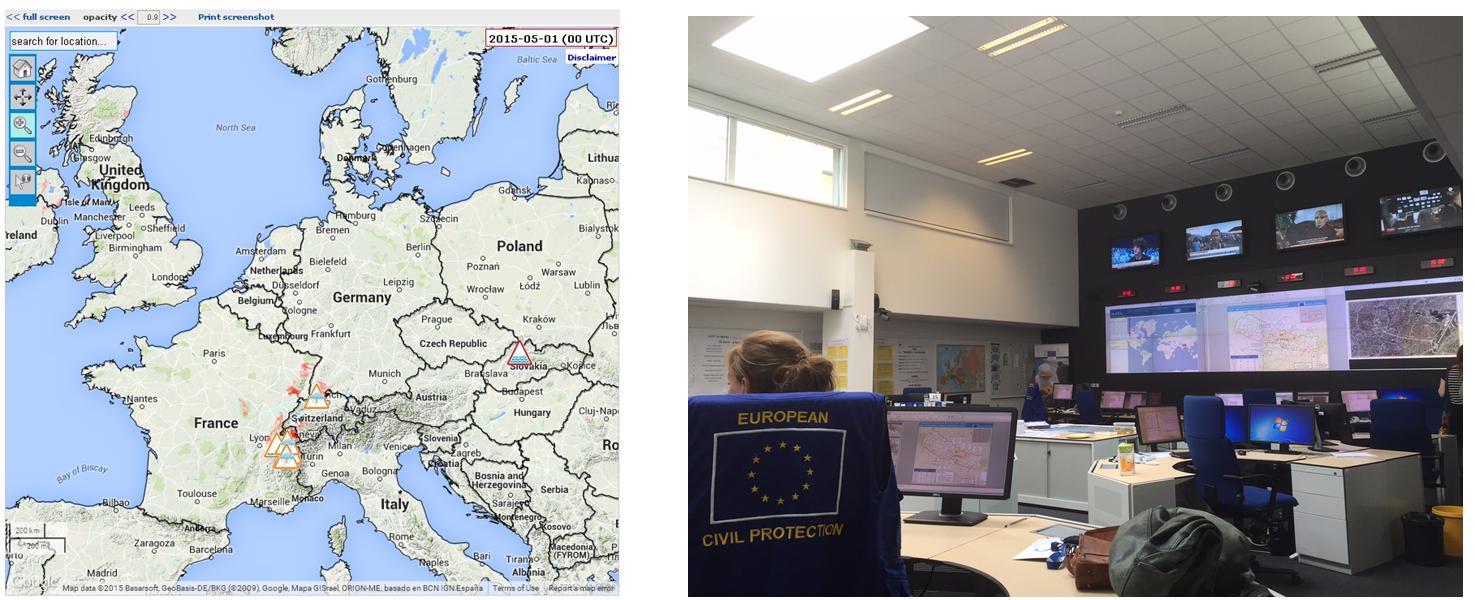
Last month I attended the 10th annual partners meeting of the European Flood Awareness System, of which the forecasting service is a member. EFAS provides forecasts across Europe, using a gridded LISFLOOD model fed by deterministic and probabilistic rainfall forecasts from ECMWF. Alerts for potential flooding are sent to the associated partners.

Picture1

EFAS display showing current alerts in Europe (left). ERCC control room (right).

The meeting took place over two days in the European Commission’s Emergency Response Coordination Centre in Brussels, with around 50 practitioners present.

The first session featured talks by those responsible for general emergency response in Europe, such the Copernicus satellite mapping system, Civil Protection, the Floods Directive and the EU Solidarity Fund, and provided a useful reminder of how EFAS is used centrally, in addition to its use by the partner forecasting services.

The second section looked to the future, and emphasised the risks we face from climate change, with the likelihood of more frequent extreme events. This is however being accompanied by increases in weather forecasting skill, around two days per decade in the ECMWF model.

EFAS processes and procedures were then covered in detail during the updates from the operational centres (Dissemination, Forecasting and Data Collection).

Picture2

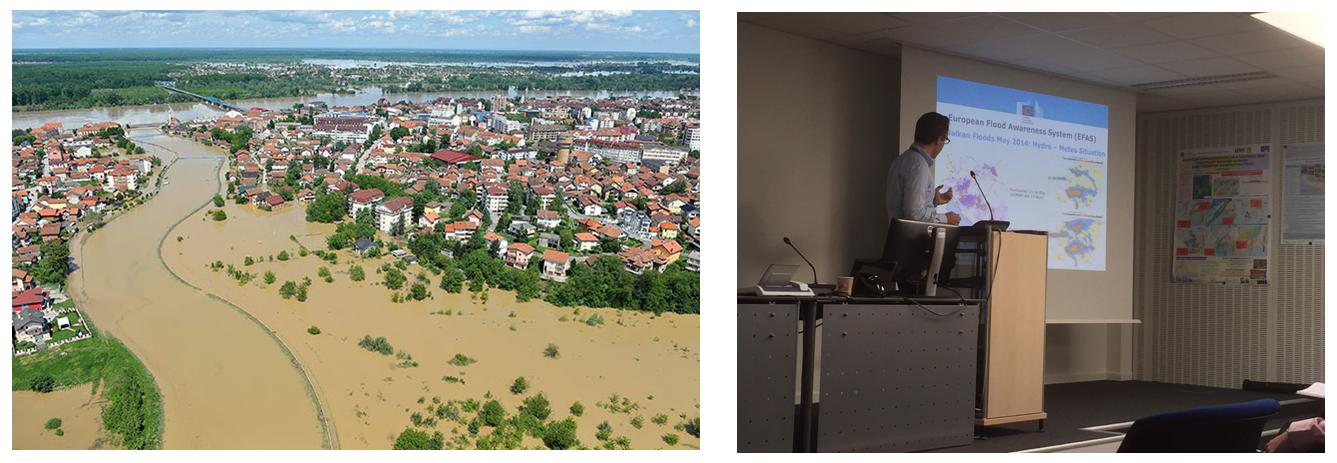
The Bosnian town of Brcko during the 2014 flood. Peter Salamon discusses the event at the EFAS meeting.

The first day concluded with some presentations to illustrate the Balkan floods of May 2014, in which more than 60 people died and hundreds of thousands were evacuated, looking at the event from first a high level view, down to a regional and then local view. It was clear that the EFAS forecasts helped greatly with the emergency planning for this event, at a European as well as the local level.

The second day commenced with a detailed overview of service updates and changes, which were agreed by those present. These included an updated flash flooding indicator, European Runoff Index based on Climatology (ERIC), and changes to the alerting process, meaning that notifications will be sent for catchments of less than 2000km2. These changes will greatly benefit us in Scotland, where our catchments are relatively small and can’t match the current criterion of 4000km2. The possible future incorporation of the European Hydrological Prediction for the Environment (EHYPE) model developed by SMHI into EFAS was also discussed.

Picture1

The Peak Box Game

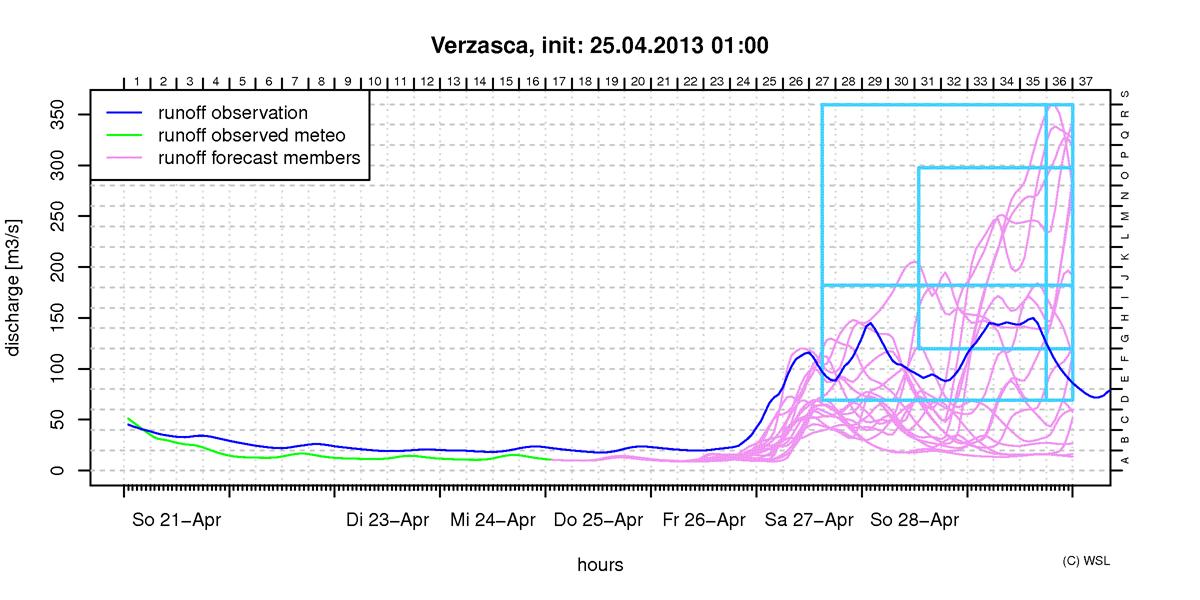
The final session was about probabilities. We are all in agreement that probabilistic forecasting through ensembles is the way forward, however it is not always appreciated that without appropriate communication to the informed recipient of the forecast we will always struggle to realise the potential benefits of this approach. The ‘Peak Box’ game illustrated how difficult it can be to interpret an ensemble forecast appropriately.

In addition to the formal business the days also provided an invaluable opportunity to meet and talk with fellow practitioners and experts in flood forecasting. Engagement of this sort is critical to the continued evolution of the forecasting service.

Posted in Conference, Forecasting, Partnerships, Research | Leave a comment

Hydrology of Scotland: some hydrometric perspectives

Dr. Andrew Black contributes the final piece of our two-part feature on the climatology and hydrology of Scotland.

Andrew Black is Programme Director for the MSc course in Catchment Hydrology & Management at the University of Dundee.  Since successfully defending his PhD at St Andrews in 1992, he was worked on a wide spectrum of hydrological projects – from flood to drought and science to management and policy – mostly on Scottish rivers.

Andrew Black is Programme Director for the MSc course in Catchment Hydrology & Management at the University of Dundee. Since successfully defending his PhD at St Andrews in 1992, he was worked on a wide spectrum of hydrological projects – from flood to drought and science to management and policy – mostly on Scottish rivers.

It’s rare to be invited to offer some personal perspectives on matters hydrological, but gives a useful chance to reflect.  It’s almost 20 years since I was appointed to a lectureship at the University of Dundee.  These days, I very much enjoy being able to relate to students how the practice of hydrology has changed over that time!

A lot of my early learning in hydrology – certainly the applied aspects – was with the staff of the then River Purification Boards.  Telemetry was beginning to get serious support after the Tay flood of 1990, and much more so after the larger and more damaging event of 1993.  However, operational flood forecasting was rather in its infancy in Scotland.  A good illustration of the state of the art from that time was the Tay flood warning system – as clearly described by Ronnie Falconer and John Anderson in their CIWEM article of 1993.

Since those early days, the real cost of hydrometric equipment has fallen steeply.  I like to think that the old question of whether to model or to monitor (always really an Aunt Sally, requiring to be refuted) has been superseded by how much monitoring shall we have to support a particular project, where, and how long for.  Catchment monitoring no longer belongs just at the outlet of the catchment of interest, but on the principal tributaries of the watercourse, at various levels below the surface and, of course, with precipitation gauges, suitably located.  The integrated approach to monitoring fluxes of water through catchment systems allows not only enhancements in flood forecasting but a better understanding of the flood generation, and so also a targeted approach to catchment flood management.

Figure 1. Ardessie Burn on 11 August 2014 – pictures © Helen Meek

Figure 1. Ardessie Burn on 11 August 2014 – pictures © Helen Meek

I’ve recently spent some time investigating the severe flooding arising from ex-Hurricane Bertha in the north-west of Scotland last August (Figure 1).  While the worst of the localised flooding around the Ardessie Burn, south of Ullapool, seems to have escaped SEPA’s river flow monitoring network, I have been able to see data gathered by an enthusiast-run Davis weather station (Figure 2), and there are also data from the vicinity from operational run-of-river hydro schemes and from a prospective scheme (Figure 3).

Figure 2 (left). Rainfall profiles for 10-11/11/2014 – data courtesy of SEPA/Phil Wild.  Figure 3 (right). Rainfall (blue circle) and river level/flow sites (orange marker) close to the Ardessie Burn (yellow star).  Mapping copyright/database right Edina/OS 2015.

Figure 2 (left). Rainfall profiles for 10-11/11/2014 – data courtesy of SEPA/Phil Wild. Figure 3 (right). Rainfall (blue circle) and river level/flow sites (orange marker) close to the Ardessie Burn (yellow star). Mapping copyright/database right Edina/OS 2015.

Figure 4.  Scottish gauging station numbers by reason for opening – Cranston & Black (1995) Proc. BHS National Hydrology Symposium, Heriot-Watt University

Figure 4. Scottish gauging station numbers by reason for opening – Black & Cranston (1995) Proc. BHS National Hydrology Symposium, Heriot-Watt University

It is not unusual for hydrometric monitoring sites installed for one purpose now finding applications in others – and indeed there’s nothing new in that.  I remember interviewing RPB hydrologists with a young Michael Cranston in the mid-1990s and discovering at first hand the cross-sectoral benefits arising as hydrometric data found new uses (Figure 4).  It’s extraordinary to note the tiny reference to flood warning (forecasting) emerging on the graph in the early 1990s, compared with the hundreds of sites now used for that purpose today.

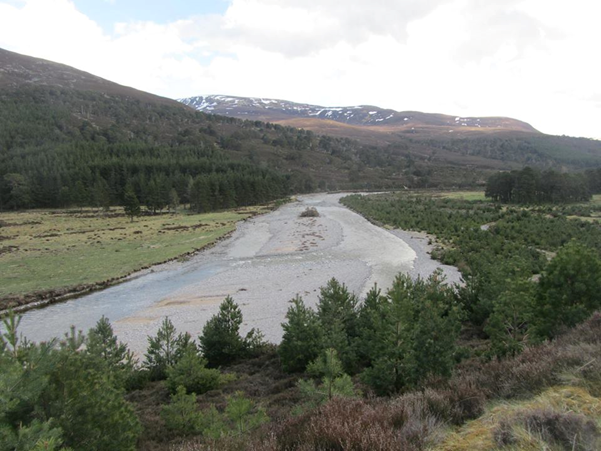
We have much the same experience operating the Glen Feshie monitoring equipment from Dundee.  While the original intention was to study the effect of scale on hydrological processes in a nested monitoring structure, we now find that there are unforeseen applications of the data we have been gathering.  With landscape-scale rejuvenation of woodland now taking place at a startling rate and density (Figure 5), a network of 20 rain gauges/weather stations plus various water level and flow gauging stations offer the potential to detect for the first time in Scotland the effects of extensive reforestation on water balance and flood response.

Figure 5. Native forest regeneration in Glen Feshie (Scottish Association of Geography Teachers)

Figure 5. Native forest regeneration in Glen Feshie (Scottish Association of Geography Teachers)

Looking ahead, I’m sure we can be confident that the diversity of drivers of change in hydrological systems – climate, land management, water management – will continue to be rivalled by a continuation in the evolution of applications for hydrological data.  For an academic, Scotland provides a fascinating wealth of contrasting hydrological systems to study.  For practitioners, that diversity often represents a challenge in terms of estimating hydrological parameters – and for which a knowledge of available hydrological data is essential.

Posted in Flood, Hydrology, Hydrometry, Partnerships | Leave a comment

The Climatology of Scotland – four seasons in one day?

Martyn Sunter contributes the first of a two-part feature on the climatology and hydrology of Scotland.

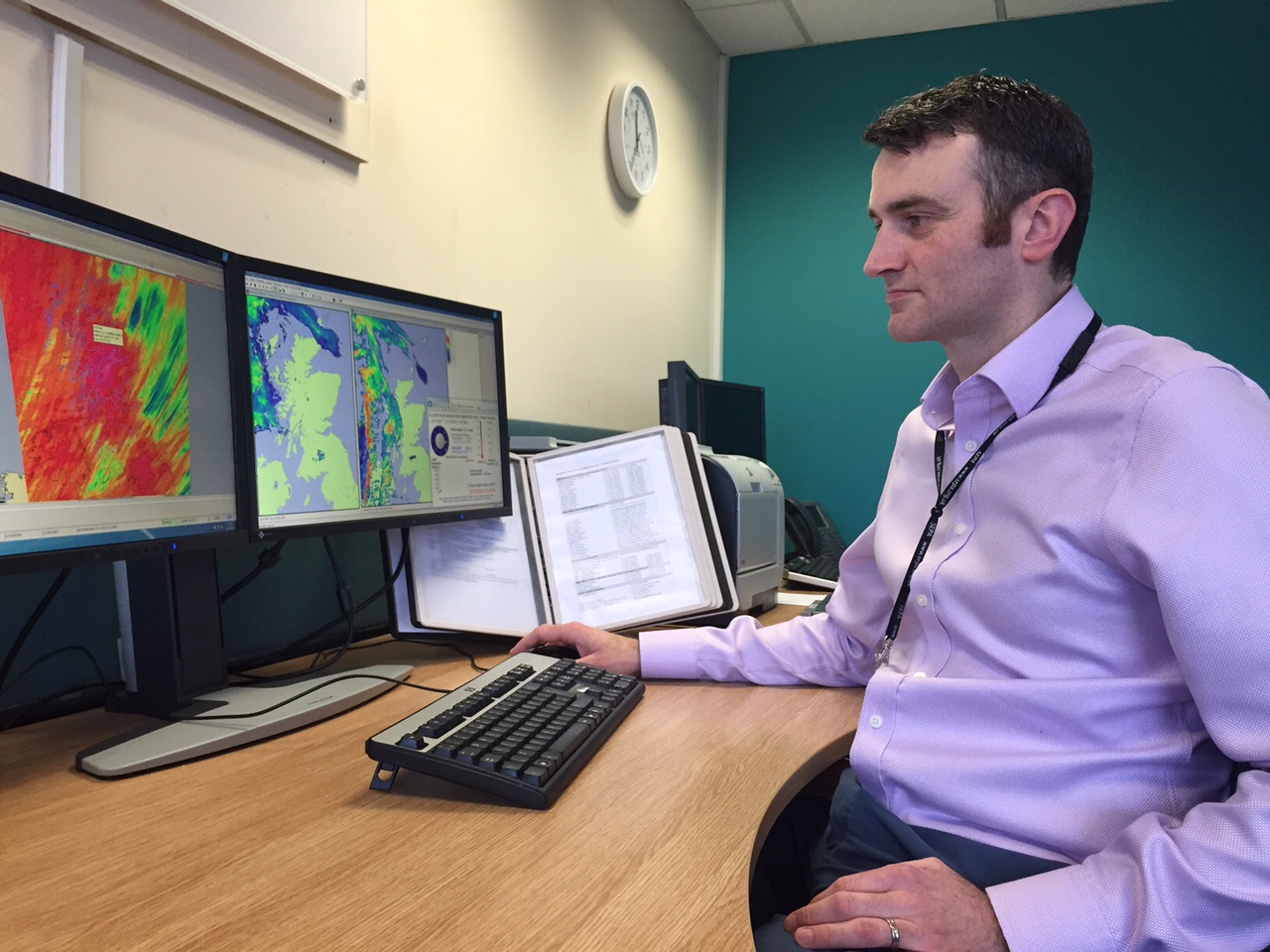
Martyn Sunter is Observations Quality Manager at the Met Office in Edinburgh.

Martyn Sunter is Observations Quality Manager at the Met Office in Edinburgh.

Having worked for the Met Office in Scotland since 1994 I have experienced the challenges of monitoring and forecasting our interesting weather and climate. Here I provide some background on the climatology of Scotland with some examples that help demonstrate some of the geographical variations, and the extremes, of our unique climate.

Why is the weather such a common topic of conversation, even for those who have lived in Scotland all their lives and surely experienced, or at least heard of, all it has to offer? If someone who had never visited Scotland asked you to describe its climate, what would you say? Perhaps you might answer that is tends to be wetter in the west, and drier in the east, but the west is usually milder in winter.  You may say it’s often cold and often windy, especially in the north. You might tell them that the spring and early summer can be dry and sunny and our warmest and sunniest days occur in the east, that’s if we escape the North Sea Haar. You could mention that the mountains and our vast coastline create large differences in the weather over short distances. Or you may answer with the often-used phrase ‘ Well, we get four seasons in one day!’
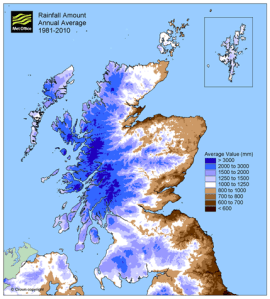
Fig 1. Annual average rainfall amount between 1981 and 2010.

Fig 1. Annual average rainfall amount between 1981 and 2010.

Most people will be familiar with the typical patterns of weather that affect our country. Our location puts us the direct line of Atlantic low pressure systems bringing unsettled weather at any time of year, being most active during the winter months when fierce storms can sweep across the country.  At the same time, we can enjoy fine, settled weather as high pressure becomes established, often bringing glorious weather during the spring time when students are busy revising for exams and facing the dilemma of deciding whether any productive work can be combined with lying in the sun! Our notoriously wet west coast and islands can experience the best weather in the country at these times as high pressure becomes established to the north of Scotland and easterly winds prevail. At the Met Office, our National Climate Information Centre produces charts, maps and summaries of our varied climate based on an interpolation of the surface observations network.

Clearly the topography of Scotland, with its steep mountains of the northwest Highlands, the Grampians further east and the Southern Uplands, have a major influence on our weather and climate. The roughly north to south orientation of our western highlands provide a barrier to the progress of weather systems and shelter to areas such as the Moray Firth. Our extensive coastline and islands and prevailing westerly wind mean that our weather is also governed by proximity to the sea. If we look at a map of average rainfall across Scotland, see fig 1, it highlights both the predominantly west to east flow of weather systems across the country and the variations due to topography. The western coast and islands bear the brunt of the Atlantic weather systems with the sheltered east coast to the lee of the Scottish mountain ranges being the driest parts of the country.
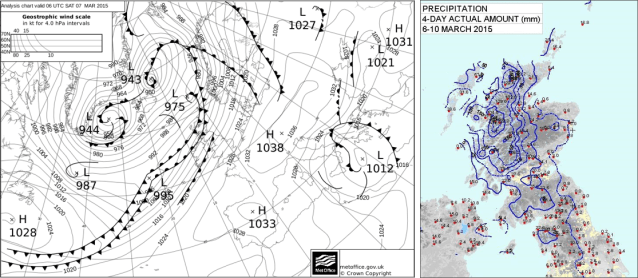
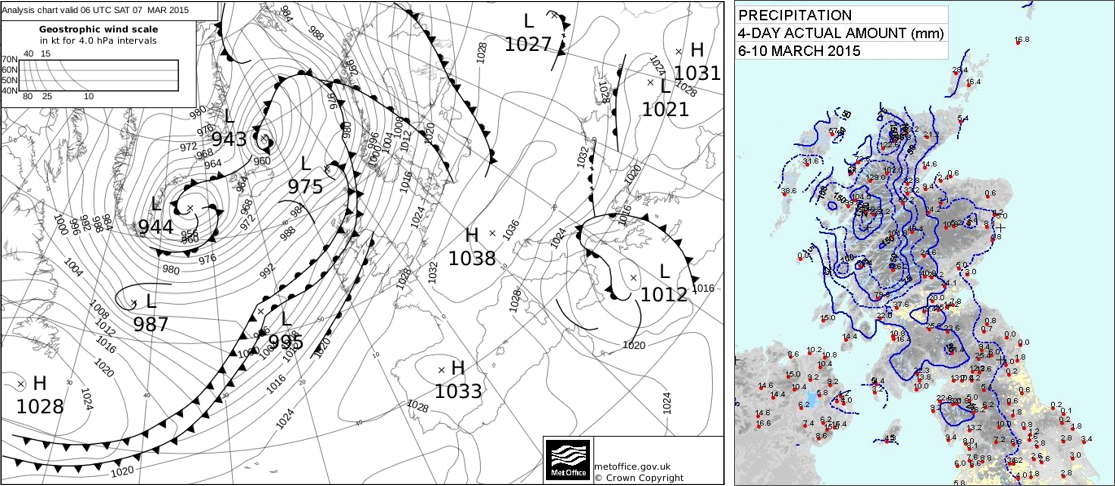
Fig 2 (left). Analysis chart for 0600UTC on Saturday 07th March 2015.  Fig 3 (right). 4-day total precipitation amount from 6th to 10th March 2015

Fig 2 (left). Analysis chart for 0600UTC on Saturday 07th March 2015. Fig 3 (right). 4-day total precipitation amount from 6th to 10th March 2015
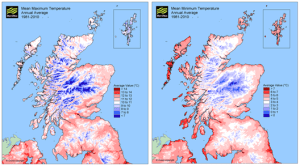
Figs 4 (left) and 5 (right). Annual average maximum and minimum temperature between 1981 and 2010.

Figs 4 (left) and 5 (right). Annual average maximum and minimum temperature between 1981 and 2010.

The heavy rain affecting western Scotland over the weekend of 7-8 March 2015 is a good example of a moist south-westerly airflow, slow moving frontal systems and orographic enhancement, with the sheltered east remaining relatively dry (see fig 2).  Flooding caused problems in a number of areas. The highest 4-day rainfall totals were not far off 200 mm (see fig 3), amounting to nearly the whole March long-term average at Plockton and Drumnadrochit.

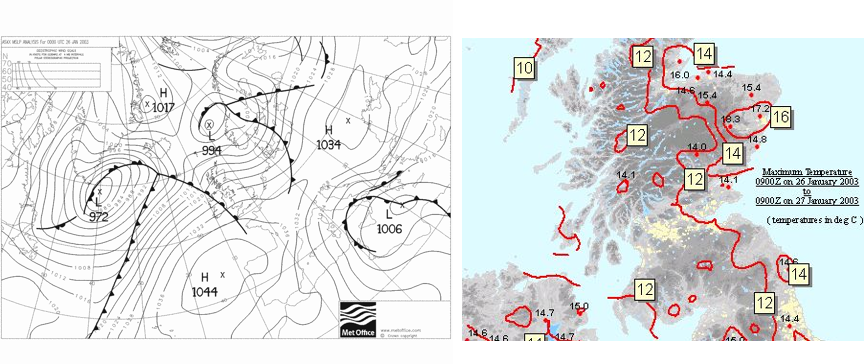
The temperature climate of Scotland is influenced by the topography and prevailing wind, (see figs 4 and 5). During warm sector conditions and westerly winds the east of Scotland (particularly to the lee of the Grampians) can experience a marked Fohn effect which can bring spring-like conditions during the winter. An extreme example of this is shown in fig 6. On 26th January 2003, record breaking temperatures for the time of year were measured in the east of Scotland (fig 7) with Aboyne reaching 18.3 Celsius (previous record was 14.1 Celsius) and Dyce reaching 17.2 Celsius (previous record was 15.1 Celsius).

Fig 6 (left). Analysis charts for 26th  January 2003. Fig 7 (right). Maximum air temperature between 0900UTC on 26 January 2003 and 0900UTC on 27 January 2003
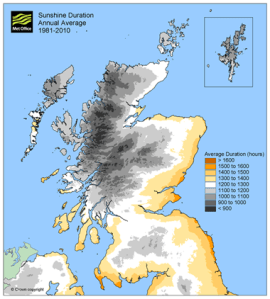
Fig 6 (left). Analysis charts for 26th January 2003. Fig 7 (right). Maximum air temperature between 0900UTC on 26 January 2003 and 0900UTC on 27 January 2003

Fig. 8. Annual average sunshine duration between 1981 and 2010.

Fig. 8. Annual average sunshine duration between 1981 and 2010.

Figure 8 shows the average sunshine duration across Scotland, which ranges from less than 900 hours over parts of the northwest highlands to between 1500 and 1600 hours over the east of Fife, the Berwickshire coast and the southwest corner of Dumfries and Galloway. This is again a function of the mountainous regions bearing the brunt of rain bearing systems from the west and the upslope effects of cloud formation in moist westerly airflows and the drying of the air mass to the lee of high ground allowing cloud breaks and sunny periods. Frequent showers, blown in on west to northwest winds, particularly during the winter when they are generated by the relatively warm Atlantic in the unstable polar maritime air, bring cloud and showers to the northwest of the country whilst areas to  the east of the Grampians and Southern Uplands stay relatively dry and sunny.
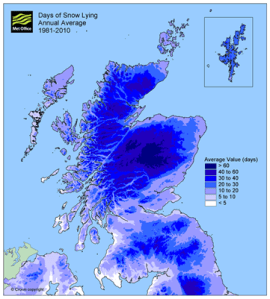
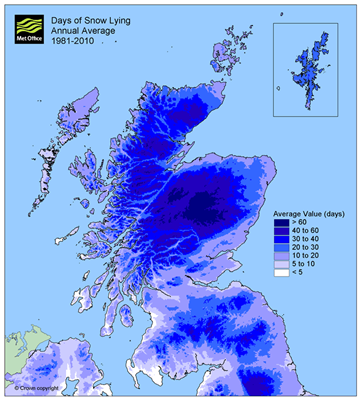
Fig 9. Annual average number of days of snow lying between 1981 and 2010.

Fig 9. Annual average number of days of snow lying between 1981 and 2010.

Finally, a description of Scotland’s climate wouldn’t be complete without a look at snow. Figure 9 shows the average number of days with lying snow per year. As you would expect, it follows the topography of the country, but looks rather different to the rainfall map of figure 1. The area affected by snow the most is centred over the Grampian mountains, with Shetland experiencing a fair amount of snow too. Snow events in Scotland are often associated with arctic air masses brought in on northerly winds, hence the reason Shetland sees more than its fair share. Similarly, the northeast of mainland Scotland is exposed to those northerly winds and bears the brunt of frequent snow showers, more organised areas of wintry precipitation associated with fronts or troughs in the northerly flow, or even polar lows. The winter of 2013/2014 saw an unusually large amount of snow affecting the hills and mountains of Scotland, which was great for the ski centres, which had almost too much snow at times, but with surprisingly little reaching low levels. A series of frontal systems brought heavy precipitation across the country, with frequent periods of heavy snow affecting the hills and mountains, but often just rain or sleet at low levels.

So can the weather in Scotland be described as ‘four seasons in one day’. I’m not a fan of the saying personally. Perhaps it refers to showery days such as in the spring time where we might have a brief rain shower and some gusty winds, followed by some pleasant sunshine and relative warmth and just a light breeze, then perhaps followed by a hail shower and squall, then back to sunshine , but now feeling noticeably colder. Or perhaps it refers to the passage of frontal systems where we can experience three different air masses in the space of one day interspersed with periods of dry weather and rain and changing temperatures and winds. But, if we live in Scotland, surely we’re used to all that, and that’s what makes our climate so interesting and challenging.

Posted in Climate, Partnerships, Weather prediction | Leave a comment

Natural hazards: prediction and early warning on various scales

The 2015 General Assembly of the European Geoscience Union provided an opportunity to share challenges and innovation in the prediction and early warning of natural hazards.  Although flooding was a key topic area, other hazards featured which all have synergies  across the various scientific disciplines.

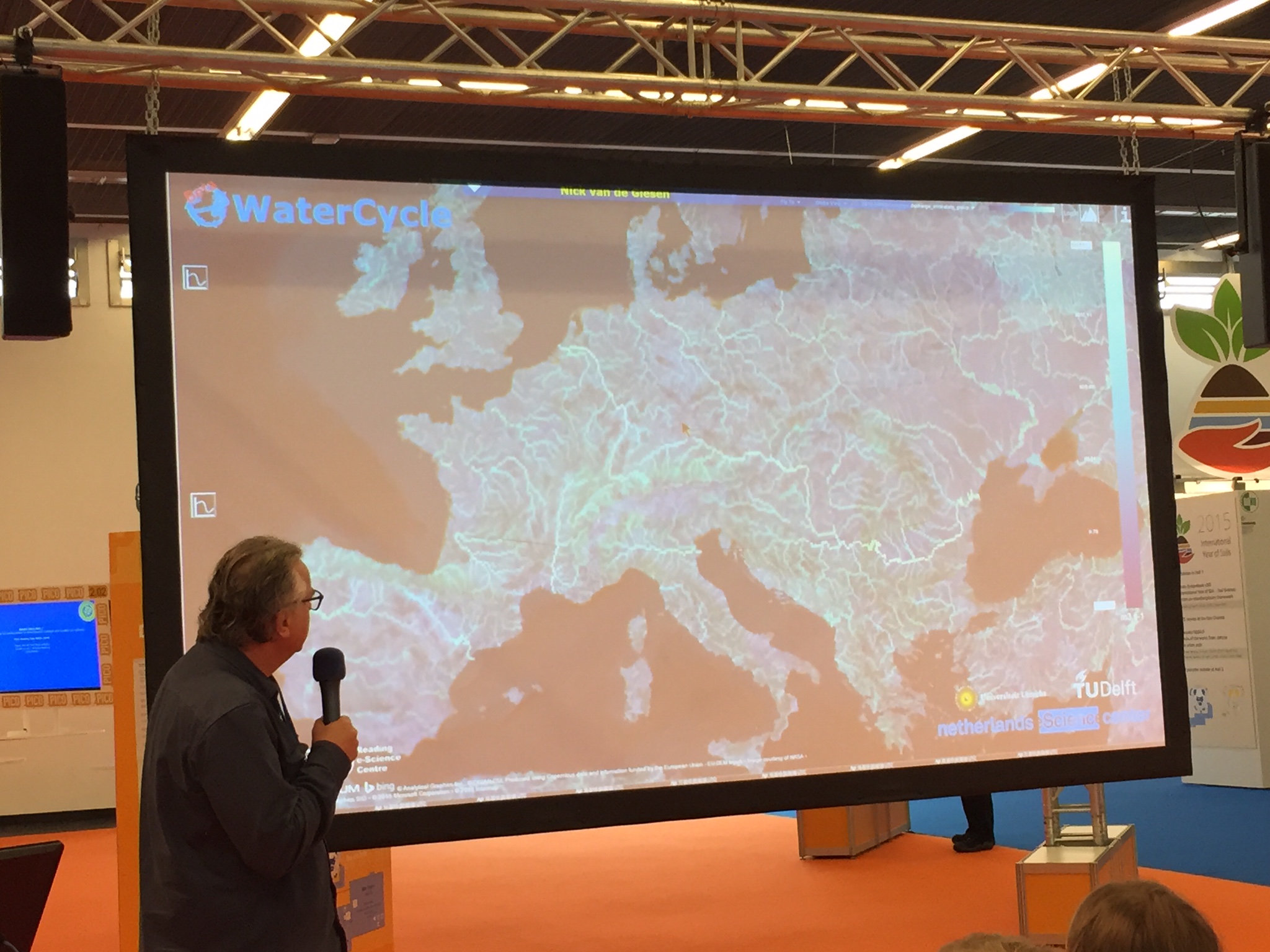
Presentation by Nick van de Giesen (Delft University of Technology) on eWaterCycle: A global operational hydrological forecasting model.

Presentation by Nick van de Giesen (Delft University of Technology) on eWaterCycle: A global operational hydrological forecasting model.

Looking at applications across the international scale, there are no better examples than the eWaterCycle – a globally distributed hydrological model, and the Global Storm Surge Forecasting and Information System – a global Delft 3D model with nearshore resolution of 5km. Developments in a continental-scale flood forecasting system across Africa which has seen a high success of flood detection verified by sources such as the Dartmouth Flood Observatory will underpin the Global Flood Awareness System (GLOFAS).  This coupled global weather and hydrological prediction system is due to go live next month.

The temporal scale of applications ranged across many of the presentations, including seasonal hydrological predictions on the pan-European scale down to 24-hour pluvial flooding in urban environments covered by our own demonstration of flood early warning systems.

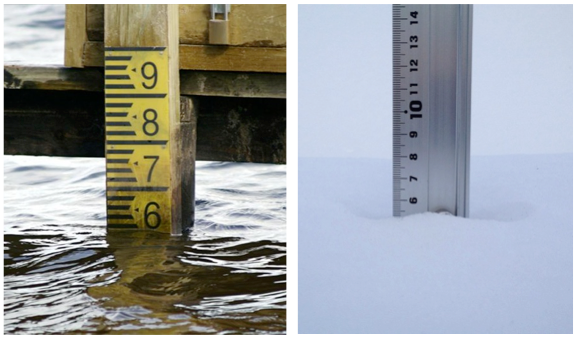
WeSenseIt is an initiative encouraging citizen observatories to allow to reporting of parameters such as flood levels and river discharge.

WeSenseIt is an EU FP7 initiative developing citizen observatories to allow the reporting of parameters such as flood levels and river discharge.

There were some excellent demonstrations of data assimilation techniques for improving flood detection or model verification, whether technological or societal.  A hydrological assessment of radar and raingauge merging was presented to highlight benefits of providing the best possible rainfall input into flood forecasting; additionally examples in the use of citizen science approaches to verify flooding such as the cases of Floodtags or WeSenseIt.

But what of decision making at times of uncertain forecasts? When faced with crisis management during flooding incidents it’s often useful to consider the full range of predictions and likely scenarios, which is where probabilistic forecasts help.  This was presented as a good example in Zurich where flood mitigation measures were acted on based on deterministic predictions with resultant significant costs.

So what can we take away from these various sessions?

  • The Norwegian Water Resources and Energy Directorate (NVE) have developed a combined early warning system for flooding and landslide risk. (Picture: Glen Ogle landslides - source bbc.co.uk)

    The Norwegian Water Resources and Energy Directorate (NVE) have developed a combined early warning system for flooding and landslide risk. (Picture: Glen Ogle landslides – source bbc.co.uk)

    Are approaches to hydrological prediction transferable to other natural hazards?  This is certainly the case in Norway where methods for flood forecasting have been utilised for the prediction of landslides using the same gridded modelling approach.  These forecasts are then presented onto a web based decision making tool.

  • Can we make more of flooding observations to verify our forecasts; where approaches by WeSenseIt or Floodtags could be integrated into flood forecasting systems such as Delft FEWS?
  • How can we make better decisions based on communication of risk and uncertainty?  Daily flood guidance is currently communicated to responders using the risk matrix (likelihood and impact), however examples of heat-wave alerting adopting similar approaches could suggest further use in the communication of flood warnings?
Posted in EGU, Forecasting, Hydrometeorology, Natural Hazards, Research | Leave a comment

Game over?

Article by Peter Buchanan, Met Office

On Tuesday 15 July 2014, the Met Office implemented ‘ENDGame’ physics into the dynamical core of its global atmospheric forecast model. This was the culmination of many years of research and development and two years of implementation and testing. At the same time, the resolution of the Met Office Global Model (GM) was increased from 25 KM to 17 KM and the resolution of the assimilation scheme from 60 KM to 40 KM.
Peter Buchanan (right) is a meteorologist at the Met Office and has over 40 years experience of working in weather forecasting and recently applying science developments in an operational environment.

Peter Buchanan (right) is a meteorologist at the Met Office and has over 40 years experience of working in weather forecasting and recently applying science developments in an operational environment.

What does mean for the Scottish Flood Forecasting Service? Improved atmospheric model performance inevitably leads to improved flood forecasting performance in all the areas of concern, namely surface water, rivers and coastal.  The GM also provides boundary conditions for ‘nested’ high resolution ‘shower permitting’ models like the Met Office UKV model (1.5KM horizontal resolution). Better accuracy and resolution at the boundaries can lead to better performance of the downstream high resolution models. Once again, good news for the flood forecaster!

Better consistency and accuracy in the atmospheric models will also improve the performance of downstream hydrological and coastal models leading to an overall improvement in the performance of the flood forecasting service.

The good news story does not end there. On 3 February 2015, the Met Office implemented ‘ENDGame’ physics into the high resolution models including the UKV.

The use of high resolution numerical weather prediction in daily flood forecasting risk assessment.

The use of high resolution numerical weather prediction in daily flood forecasting risk assessment.

So, is this really the ‘ENDGame’? Of course not! As we get better, expectations also increase and increased expectation and confidence in our products lead to better and more focused responses to flood events. Potential changes in the climate may also lead to more frequent and more severe events. The flood forecasting community therefore needs to match these challenges through a process of continuous and user focused development.

So what now? The Met Office recently announced a significant new investment in supercomputer capacity. The Cray®XC40™ will become operational in September 2015 and reach full capacity in 2017. This will keep us at the forefront of environmental science high-performance computing and help to deliver significant socio economic benefits through enhanced resilience to severe weather and related hazards.

How will the new supercomputer benefit the flood forecasters? Various options are being considered which include improved resolution, more frequent running of high resolution models and better exploitation of forecast ensembles. Parallel science and technical developments, in both the meteorology and the hydrology, will provide a platform that helps keep the flood forecasting service at the leading edge of the crucial services it provides.

Looking further ahead, ENDGame will eventually be replaced by a new dynamical core and work towards this has already commenced. Like the weather, the associated R&D never sits still!

Posted in Forecasting, Research, Weather prediction | Leave a comment