
Our latest blog comes from the DelugeAI CREW project team (Christopher White, Douglas Bertram, Robert Atkinson, Muhammad Usman, Kamila Nieradzinska and Victoria Martí Barclay) at the University of Strathclyde on the exciting developments in the Artificial Intelligence space.
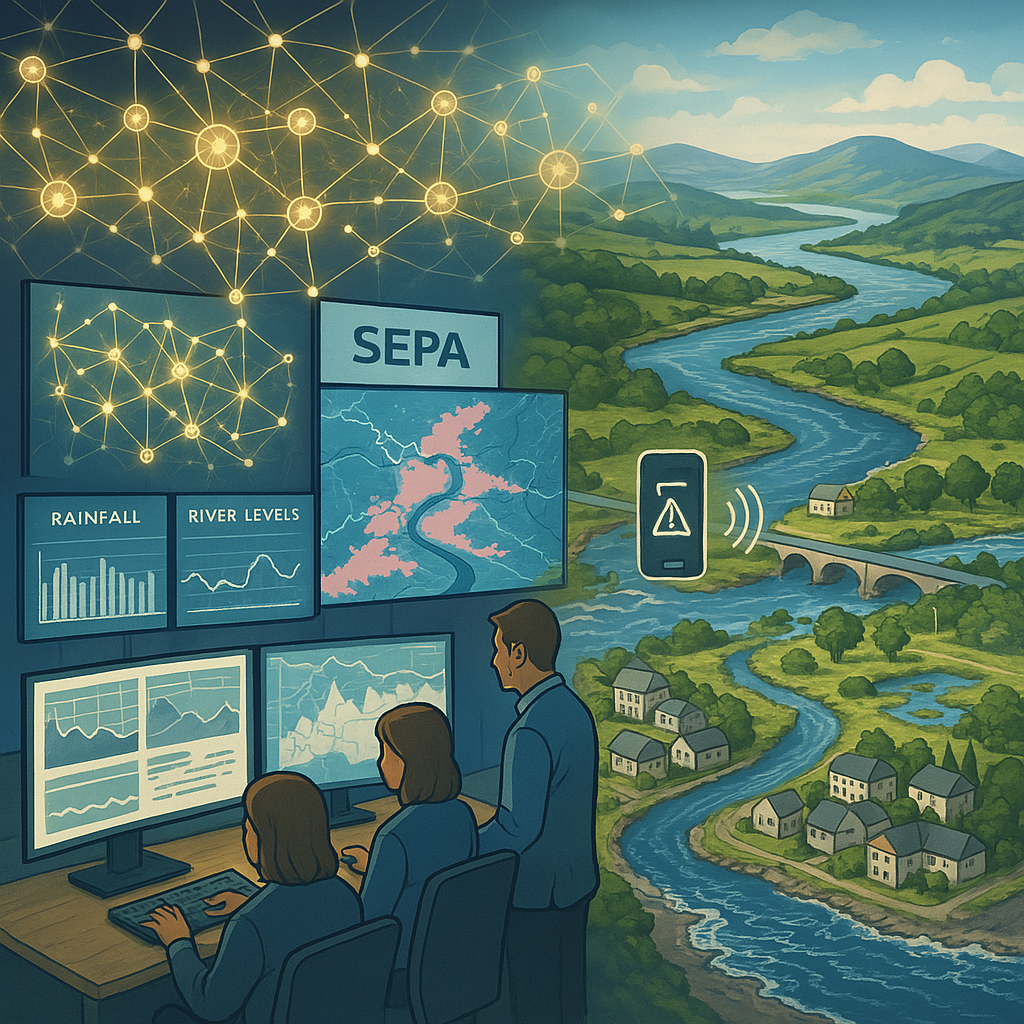
Can we harness Artificial Intelligence (AI) and Machine Learning (ML) to improve flood forecasting in Scotland? The short answer is yes. The longer answer is still yes, but there are many things to consider – from the data and resources available to the ethics, transparency, and staff training required to use AI responsibly. The DelugeAI project, delivered through CREW by researchers from the University of Strathclyde, recently carried out a rapid review of how AI/ML is being used in flood forecasting across the world, and what that could mean for Scotland.
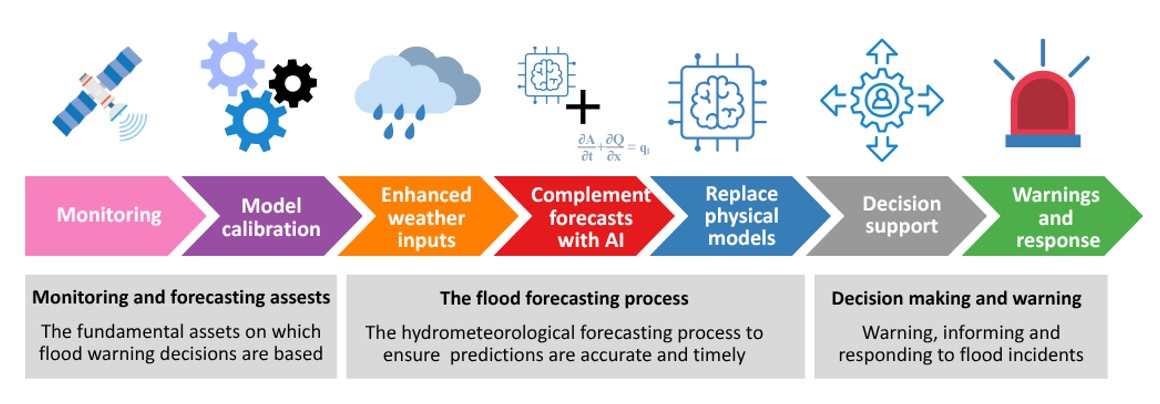
Working closely with SEPA, the team developed a framework that maps out the key stages of flood forecasting, from monitoring and model calibration to decision support and issuing warnings. This framework was used to guide the review, helping identify where most AI research and applications are currently focused, and where there are still gaps. It also allowed the team to consider how AI might be used to strengthen each part of the forecasting chain, rather than viewing it as a single tool for prediction.
Globally, AI-based flood forecasting tools, such as Google’s Flood Hub, have already made a significant impact. Flood Hub provides forecasts in over 80 countries, including areas where forecasts did not previously reach, highlighting the huge potential of AI and ML. Closer to home, initiatives like FloodAI in Northumberland are developing a network of sensors for monitoring and early warning for rural communities in small catchment areas, areas where the traditional hydrodynamic models fall short. These real-world examples show how AI can fill critical gaps in flood forecasting.
“We haven’t yet fully grasped the potential of these technologies. Our existing research and operational ecosystems—encompassing models, infrastructure, and workflows—were designed for a different paradigm. In many ways, we’re like early humans confronted with a car: unfamiliar with driving or repairing it, accustomed only to walking. This analogy underscores the challenges we’re facing. The uneven progress in AI adoption often stems not from the technology itself but from our systems, expectations, and readiness to rethink long-standing assumptions.” Florian Pappenberger – Director General (elect) ECMWF
A key takeaway from the review is the importance of clearly defining the problem before selecting an AI tool, as different types of tasks require different approaches. For example, turning satellite images into flood maps is a spatial (2D image) problem, which can be tackled using convolutional neural networks (CNNs), as seen in recent work by NIWA in New Zealand. In contrast, using recent rainfall data to forecast future flooding is a time series problem, often addressed with models like Long Short-Term Memory (LSTM) networks, an approach used by AI4Flood. If the goal is to support decision-making based on structured inputs (such as thresholds or classification), tree-based models may be most effective. In more complex situations, the best solution may involve combining multiple machine learning models, each addressing a different part of the forecasting process.
After looking at the peer-reviewed academic literature, operational projects, and through discussions with experts, there was a clear consensus: AI and ML works best when used alongside traditional numerical models, not instead of them. This “hybrid” approach, where AI helps collate and interpret data, fill gaps, or speed up decision-making, is proving more effective and trusted than trying to replace traditional models. Additionally, hybrid models are increasingly favoured as they improve accuracy and speed but are still bound by physical models, which increases trust in the forecasts, a big concern around AI applications.
Building on the review, the team carried out a feasibility study for implementing AI/ML in SEPA’s flood forecasting framework and recommended a phased approach. Start with “quick win” applications, such as using open-access tools, piloting AI for early warnings, and supporting operational decision-making. Over time, SEPA can explore more complex uses, such as model calibration and monitoring in small catchments. Crucially, all AI/ML systems should be transparent, trustworthy, and supervised by human experts.
The project concluded that by investing in the right skills, building ethical frameworks, and choosing tools carefully, Scotland can take advantage of AI in a way that enhances the current approach to flood forecasting. AI and ML won’t replace expert judgement, but it can support it, helping increase flood resilience and keep people safe in a changing climate.

 Scottish Flood Forecasting Service